
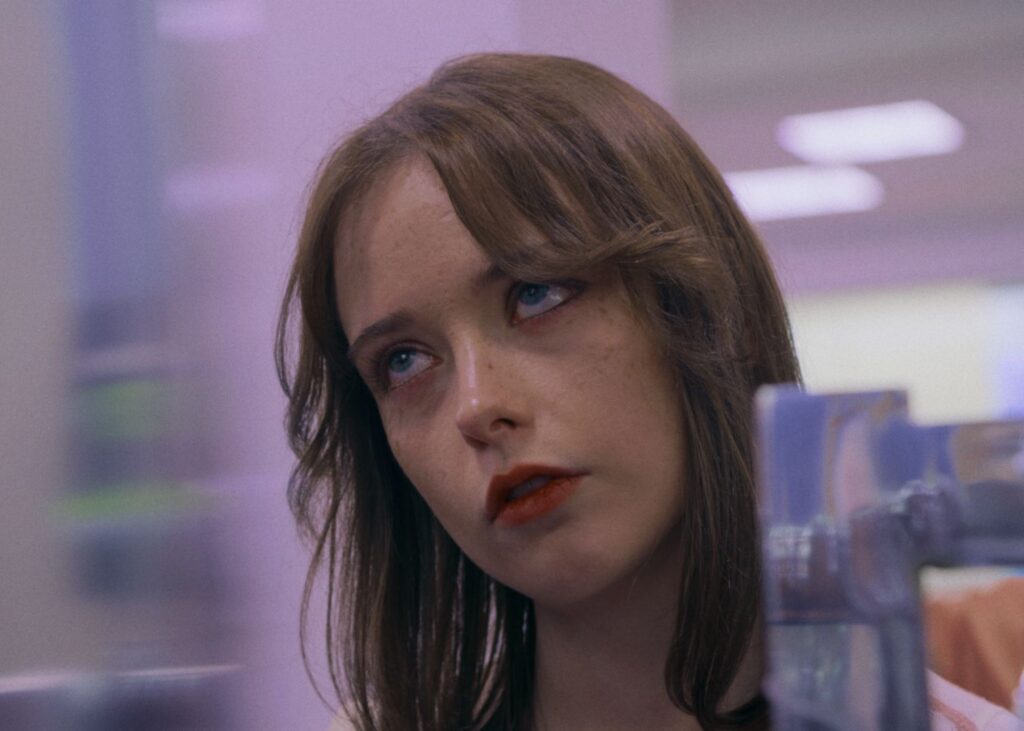
Imagine you’re hanging out with your roommate, having casual conversation, and then you both return home from the supermarket to see six men laid on the floor licking the pavement. That’s exactly what happens to Ricky (David Brown) and Tepper (Chase Williamson) in Harrison Atkins’s Sour Minnows, which had its world premiere at Fantasia International Film Festival on 24th July.
As soon as Ricky and Tepper are back in their apartment, it starts happening. Tepper mentions the men licking the pavement, but Ricky doesn’t know what he’s talking about. “We dropped our groceries, man,” Tepper says, trying to jog his memory. But Ricky still doesn’t remember. This thread carries throughout the film. Ricky asks Tepper if he wants to watch a film. “Again?” Tepper asks. “I’ve just downloaded it.” “Are you doing a bit?” “No.” “Are you?” “No.” Tepper says, “I literally feel like we just watched it.” But Ricky doesn’t seem to think so. Time stretches and bends into new dimensions. Reality becomes malleable. And it’s all the work of “The Yellow Thing,” a strange and volatile entity that wears people like costumes.
Alongside these confusing experiences, Ricky listens to flagged AI transcripts for work—which already feels like a nightmare—and spends time with fellow cinephile Aura (Suzanna Son) when he’s not hanging out with Tepper. Sour Minnows is set in the present day but has a very ‘90s feel to it, a hangout movie at its foundation. One of its major strengths is how realistic the dialogue and performances are, but one wouldn’t work without the other. It’s a credit to Brown and Williamson’s natural performances which bring authenticity and levity to quite complex and heavy themes. Much of their dialogue covers mundane, every day notions, yet remarkably never feels dull. There’s humour in Atkins’s script which arrives exactly when you want it, adding to the absurd world the characters find themselves in.
Sour Minnows feels like Atkins looked at our post-pandemic world and thought, Yes, this is all really quite strange and fucked up, we’re definitely in the wrong timeline, and decided to capture that feeling in a film—which he achieved. For many, life feels like a waking nightmare as our everyday comforts have seemingly vanished and been replaced with AI job postings, algorithmically generated news, depleted attention spans, and unintentional isolation. “The Yellow Thing” serves as an alternate explanation, a disruptor—something inhuman and indecipherable that could be responsible for generating such chaos. Still, Ricky continues to look for meaning in the mess.
Sour Minnows is a surreal experimental film, with many moments that feel truly Lynchian. It always feels one step removed from reality and captures the feeling of being “out of it,” as Ricky once said to Aura. Think of the unsettling tone that Lost Highway evokes. You can find that here. Sour Minnows is made for watching alone at 1AM on a small TV screen. There are plenty of strange effects such as when Tepper kind of folds into himself on the couch or when a translucent arm reaches out of a car’s steering wheel and smears something on the seat. There’s normal dialogue that sounds menacing, voiceovers that echo from a distant reality, dissolves that overlay images, sound design that carries unnerving tones, tight camerawork that feels claustrophobic, and a dead actor who may or may not actually be dead. All of these work effectively to create a disquieting distortion of reality.
By the time the credits roll, you may not understand what “The Yellow Thing” is, but that’s intentional. Atkins’s priority was to immerse the audience in the emotional experience of living somewhere just slightly askew from reality. Sour Minnows lingers in your memory less as a coherent story and more as a mood—one you might catch yourself slipping back into days later, wondering if you ever returned at all.

Leave a Reply