

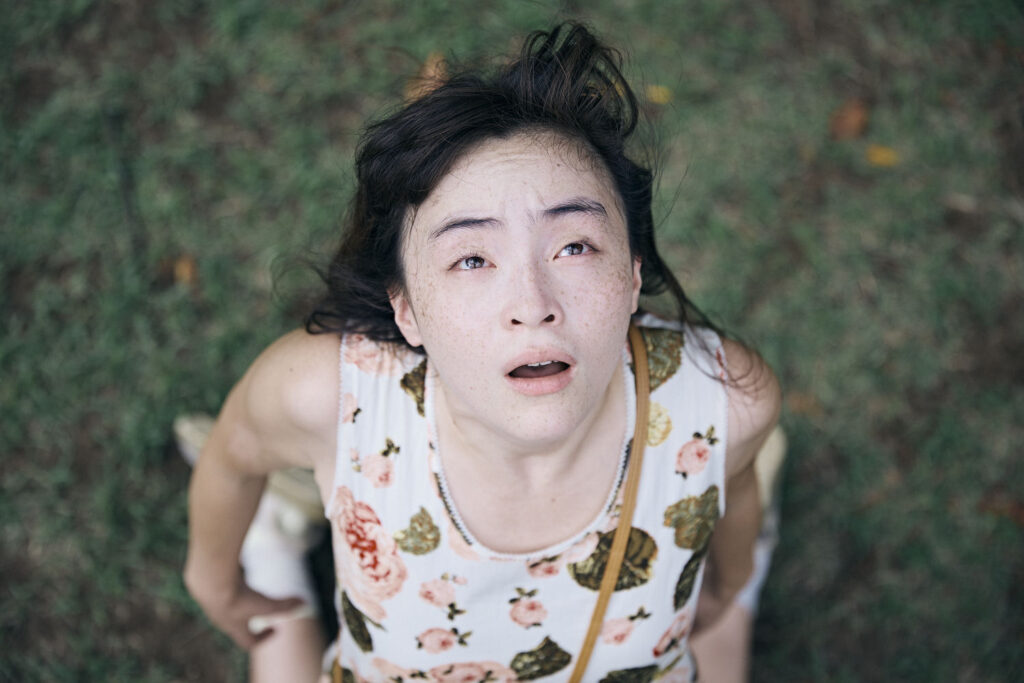
Eriko Katagiri’s When You Open the Door had its world premiere at Fantasia International Film Festival on 25th July. The film, which was written by Katagiri and Tomoko Shinozuka, follows 27-year-old Miki (Serena Motola). She wakes up in her small apartment from her sleepy memory of herself as a child, with a red-haired doll and the sounds of summer mixed with a grandfather clock chiming at the hour. Upon waking, Miki sits up slowly and does nothing for a few beats before reaching over to grab a small box on her bedside table. Inside lies a small mirror, which she holds up—big enough to see only one eye at a time—and a lipstick, which she applies. She is a very pale looking woman with light freckles scattered across her face—quite a rare and unique appearance for a Japanese woman. Then, Miki gets out of bed and we are introduced to the small qualities of her life: her pet bird, a white Java sparrow, her boyfriend, and the architectural firm she works at.
Everything moves at an unhurried pace. Miri’s firm, which features a communal office workspace, and her small apartment offer insight into her small, quiet, and isolated life. Her boyfriend snores at night, causing her to lose sleep—she stands at the sink drinking a glass of water and talks to her bird. At work, Miri sketches a building and is told by a colleague that the way she draws is very distinctive. Miki happily repeats these words to herself on her way home, taking in the compliment as though it is rare for her to receive one. The mise-en-scene feels like an old photograph, a memory that is being captured. It carries dreamy, lazy, and gentle qualities amongst its soft colouring of beige, white, and grey. It feels crispy and fresh, despite feeling like being in a dream or memory. Cinematographer Akiko Ashizawa achieves this by focusing on normal, everyday locations, balancing silhouette, shadow, and nature.
Miki’s life changes when she’s bitten by a wolf while on her lunch break—but of course no one believes her. Wolves are extinct in Japan and all traces of her bite have disappeared. Soon, Miki finds herself invited to a moon-watching gathering at night, hosted by an older woman. Still haunted by memories of the past, which seem to have prophesied these events, Miki begins to undergo a transformative experience that is captured effectively by Motola’s intense physical performance. When You Open the Door is an unconventional werewolf movie in that it doesn’t feature a gnarly werewolf attack or transformation scene, nor a lot of kills. Miki’s transformation is subtle—her nails grow longer and hair grows in new places, but it’s mostly internal. Miki isn’t ravenous for blood, but for drastic change to her boring and isolated life. Invited to “opens the door,” Miki becomes more aligned with her true self.
When You Open the Door is largely quiet, filled with natural sounds which ground us in Miki’s world and add to the film’s overall languid energy. When the score does kick in, it’s effective. The film doesn’t rush through its events, it’s a slow burn that asks for patience as you spend time getting to know its protagonist. With little dialogue, it still manages to deliver a sense of Miki’s interiority while keeping the audience at arm’s lengths, which aids in its exploration of contemporary loneliness. Katagiri and team are also very creative with their low budget, particularly in replacing a human heart with a giant gummy one and the way they show the werewolf attack, which was very inventive and speaks to the film’s unique style and voice.
East Asian folklore encompasses a rich tapestry of stories to pull from, many of which are haunting and chilling, making them perfect material for horror films. When You Open the Door references the legend of Itako—blind women who train to become spiritual mediums in Japan—but does little with it. The film starts strong but gets lost in its third act, which is thanks to the protagonist being kept at a distance, something that both aids and hinders. There are two scenes which explain what’s going on in the mythology very clearly, but the film refuses to spell things out when it comes to Miki. It relies on the audience to put together what happened in her past and how it relates to her present, alongside how her transformation fits into this and gives her a sense of belonging. It dives into a dark finale, but feels somewhat disconnected in what it allows us to see of Miki’s journey. When You Open the Door remains an intriguing film with excellent filmmaking and great performances that gets its dreamy, eerie atmosphere just right. If you’re looking for a different take on the werewolf movie, then you’ve just found it.

Leave a Reply