
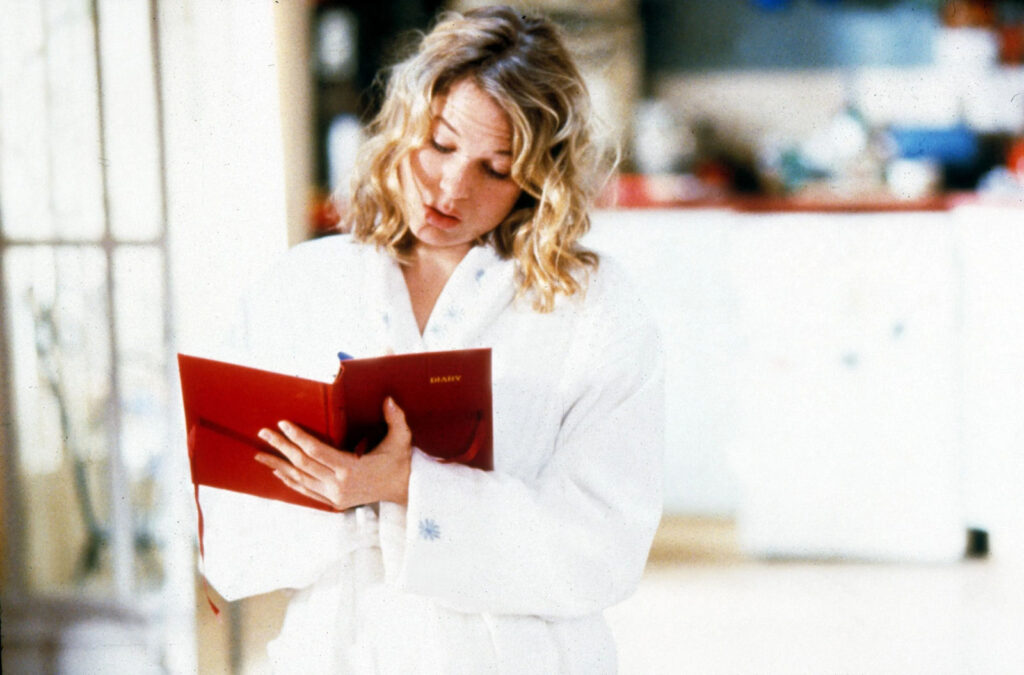
With Bridget Jones’s Diary celebrating its 25th anniversary this month, it occurred to me that it was one of the last romantic comedies that came out before everything as we knew it changed. It was before 9/11, the Iraq War, the 7/7 London Bombings, and the global financial crash of 2008. Only a decade after the film’s release, everything would be different and would never be the same again. While the film was released in 2001, Helen Fielding wrote the novel in the mid-90s during the height of Cool Britannia, a period of renewed pride and optimism in Britain. Bridget Jones’s Diary isn’t self-conscious about its Britishness, as it proudly portrays an aspirational middle-class lifestyle that was popular in romcoms of the late 90s—something that actually felt attainable to viewers who could relate to Bridget’s likely modest salary. This idealistic portrait of what life in Britain could be like is aided by gorgeous visuals, a credit to cinematographer Stuart Dryburgh and the now cosy and nostalgic feel of 35mm film.
Bridget Jones’s Diary follows the titular Bridget Jones (Renée Zellweger), an average 32-year-old British woman who is struggling to become what society tells her she should be: thin, sophisticated, certainly a non-smoker, and definitely not a drinker, all of which should help her find the right kind of man. Beginning at her parents’ New Year’s party, Bridget finds herself wearing a relatively hideous outfit, chosen by her mother (Gemma Jones), as she is reintroduced to Mark Darcy (Colin Firth), a childhood acquaintance who is now a barrister. Helpfully reminded that Bridget used to run around naked in his paddling pool as kids, the class dynamics are made crystal clear. Bridget thinks Darcy is rude, arrogant, and boring, while Darcy thinks Bridget is a vulgar and foolish “verbally incontinent spinster,” the latter of which she overhears. Following this embarrassing display of events, Bridget decides her New Year’s resolution will be to turn her life around. She buys a diary to chronicle her attempts to lose weight, quit smoking and drinking, and finally find Mr. Right.
As a publicity assistant at a publishing company in London, Bridget spends her time fantasising about her attractive and charismatic boss, Daniel Cleaver (Hugh Grant), a fantasy that soon turns into a reality. As a self-described “singleton,” an office romance is an exciting switch up—particularly as Bridget alternates the rest of her time embarrassing herself at work. Before delivering an important speech at a book launch, Bridget psyches herself up, repeating “I am the intellectual equal of everyone here,” before she awkwardly and unintentionally insults literary guests Salman Rushdie and Jeffrey Archer. Cleaver looks on amused and seemingly endeared by Bridget’s social blunders, while Mark appears to be suffering from deep secondhand embarrassment. It’s perhaps the right way for the pair to respond, given that Darcy comes from old money with his country house, aloof sophistication, traditional values, and a career in law, while Cleaver comes from new money with his smooth-talking charm and slippery morals, both informed by his womanising nature.
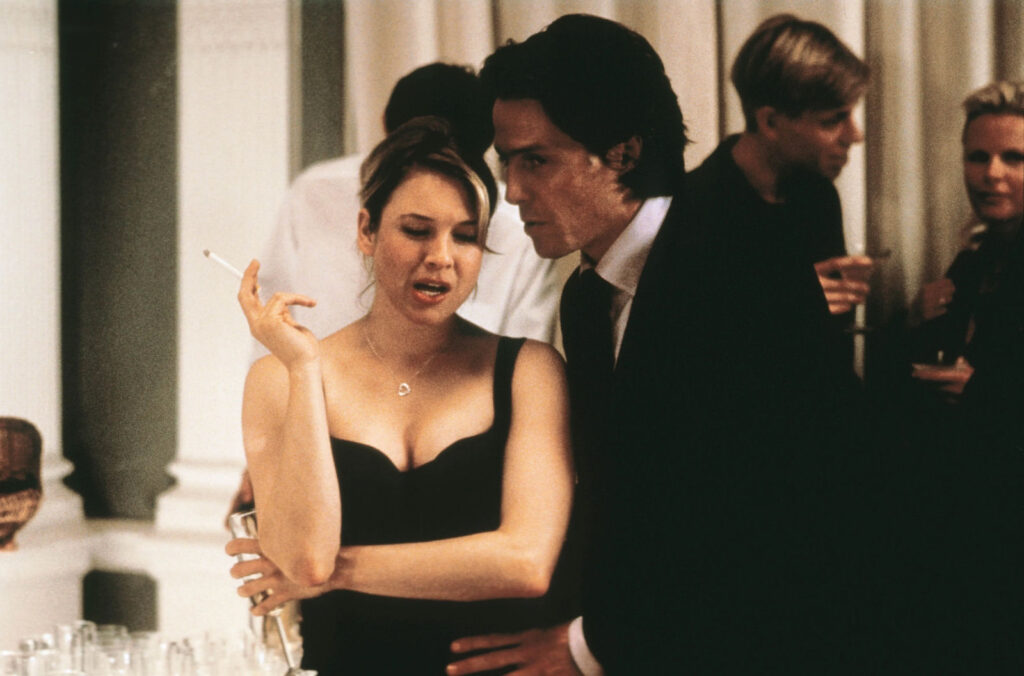
The pressure Bridget feels to look a certain way and be in a relationship mainly comes from her mother—an inner voice she has internalised—but it also comes from others, even people she doesn’t really know. At a dinner party, a man tells Bridget that she needs to get “sprogged up” because the “clock’s a’ticking,” as his heavily pregnant wife sits beside him. This follows a discussion on why someone would be single in their 30s. The film is interesting, however, in the sense that men don’t really care about how Bridget looks, or whether she drinks or smokes for that matter. Not only do Darcy and Cleaver find Bridget attractive just as she is, but her colleague Mr. Fitzherbert (Paul Brooke) is always looking at her breasts, and her “uncle” (James Faulkner) is always touching her ass, which demonstrates that Bridget is a perfectly attractive and desirable woman—even if it comes at the cost of good old fashioned sexual harassment.
During an intimate scene, Cleaver discovers Bridget’s granny compression underwear, which Bridget expresses embarrassment over—but Cleaver immediately puts her at ease with his effortless charm: “No, I like them. There’s absolutely nothing to be embarrassed about. I’m wearing something similar.” Of course, Cleaver later finds a younger, thinner, and more confident woman in his American colleague Lara (Lisa Barbuscia)—who says, “I thought you said she was thin”—but Cleaver still comes crawling back to Bridget some time later. Darcy’s girlfriend Natasha (Embeth Davidtz) is also a thin and sophisticated career woman, who makes a negative comment about Bridget’s Playboy bunny costume when she didn’t get the memo that the party’s theme of “Tarts and Vicars” had been done away with. Natasha also calls Bridget “childish” when she and Cleaver are having fun splashing around on rowing boats in the lake. This highlights the ways in which women engage in toxic femininity, seemingly for the approval of certain men.
While Bridget seems able to afford a busy and exciting lifestyle of smoking, drinking, taking taxis, hanging out with friends, and going out to dinner parties, there is a sense of realism in her ordinary clothes, many of which appear creased and unironed. It allows for a striking scene later in the film when Bridget comes out of her flat looking incredibly put together, donning sunglasses and a headscarf à la Grace Kelly or Audrey Hepburn, before climbing into Cleaver’s top-down convertible, ready for a mini getaway. Of course, the wind blows her headscarf down the road and she arrives at the country inn with an entirely new hairdo resembling a bird’s nest. To top it off, her new look is greeted by judgemental glances from Darcy and Natasha. Bridget was trying to live a picture-perfect fantasy that resulted in disaster—one of the many relatable scenes the film has to offer, especially as Bridget was trying to be someone she’s not.

Bridget Jones’s Diary succeeds in giving us a central protagonist who is highly relatable in her imperfect behaviour. She is charming, awkward, endearing, embarrassing, sexy, messy, funny, vulgar, clever, and stupid—a mix of traits that reflects the true nature and complexities of real life. She isn’t a one-note character. Ultimately, Bridget is at her best in each area of her life when she’s being her authentic self and not who society says she should be. This is, after all, how she attracts Darcy, which was completely unintentional. It works because neither party pretends to be someone they aren’t, and their honest, messy, and humorous monologues to one another (during different parts of the film) prove that they are drawn to each other in spite of their flaws — flaws that we often go to great lengths to hide when courting.
Mark: “I don’t think you’re an idiot at all. I mean, there are elements of the ridiculous about you. Your mother’s pretty interesting. And you really are an appallingly bad public speaker. And, um, you tend to let whatever’s in your head come out of your mouth without much consideration of the consequences. I realised when I met you at the turkey curry buffet that I was unforgivably rude and wearing a reindeer jumper that my mother had given me the day before. But the thing is, um… what I’m trying to say, very inarticulately, is that, um, in fact… perhaps despite appearances, I like you. Very much.”
Bridget: “Apart from the smoking and the drinking and the vulgar mother… and the verbal diarrhoea…”
Mark: “No, I like you very much. Just as you are.”
Bridget: “You once said you liked me just as I am and I just wanted to say likewise. I mean there are stupid things your mum buys you, tonight’s another… classic. You’re haughty, and you always say the wrong thing in every situation and I seriously believe that you should rethink the length of your sideburns. But, you’re a nice man and I like you. If you wanted to pop by some time that might be nice… more than nice.”
Mark: “Right. Crikey.”
It’s easy to argue that Bridget Jones’s Diary isn’t a feminist film because Bridget ends up with a man instead of choosing herself. But there are other films for that. It’s human nature to desire a romantic and sexual relationship, which isn’t something women should feel ashamed to pursue. The film delivers major lessons in learning to respect yourself as Bridget’s character development involves not settling for toxic partners like Cleaver, finding confidence in being herself, and continuing to value her friendships. Bridget Jones’s Diary also proves that making a fool out of yourself isn’t the end of the world. Life goes on—and so do you.


Leave a Reply