
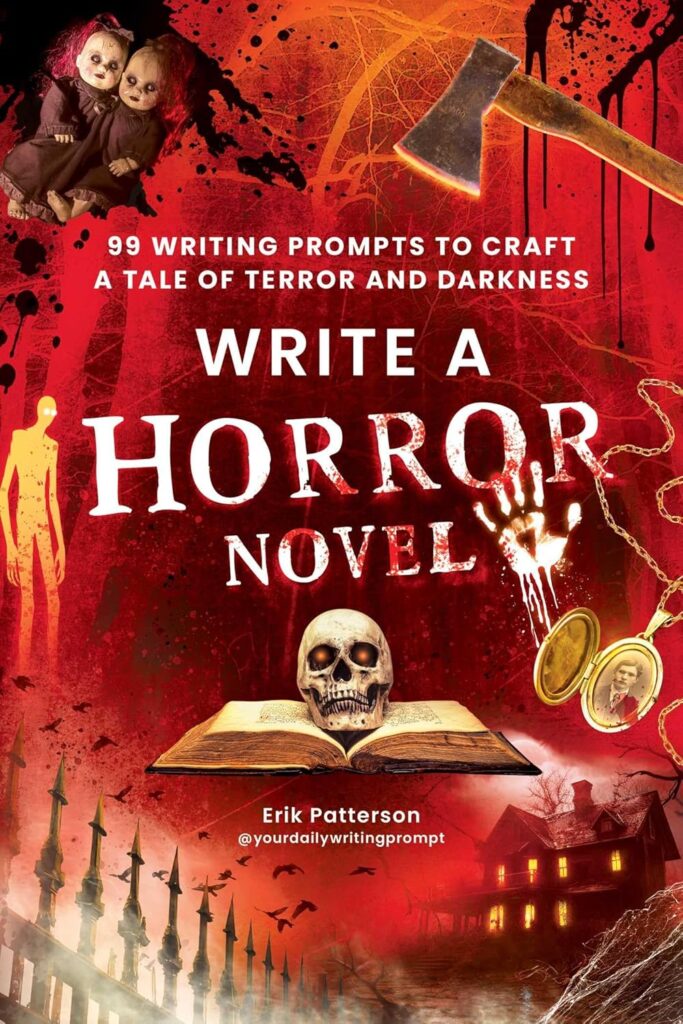
Write a Horror Novel: 99 Writing Prompts to Craft a Tale of Terror and Darkness is Erik Patterson’s third entry into his Writing Prompts series, following Write a Romantasy and Write a Dystopian Novel. Patterson has been making a name for himself on TikTok under @yourdailywritingprompt with 317k followers, but he’s also the screenwriter (with writing partner Jessica Scott) behind teen hits such as Another Cinderella Story and Radio Rebel, starring Selena Gomez and Debby Ryan, respectively. He’s also written a couple of horror films, including Abandoned starring Emma Roberts. This film follows a young couple who move into a farmhouse with an infant son. Sara (Roberts) believes the house is haunted, but her husband Alex (John Gallagher Jr.) thinks she is suffering from postpartum psychosis–which leaves the audience to question which perspective is true. It’s a set-up we’ve seen countless times with many common tropes (a common theme or device), but unfortunately it remains predictable and adds nothing new, despite a generally good depiction of postpartum difficulties.
I know what you’re thinking: why should I take writing advice from a guy whose film you just told me kinda sucks? The answer is because Patterson still knows his shit. He’s got tropes locked the fuck down. I also have a genuine soft spot for Another Cinderella Story, and I wouldn’t lie about that. Tropes are often written off as tired and predictable cliches, but they are important for storytelling. These consistent and recurring themes are things horror readers come to expect and search for, but it’s an author’s job to take these familiar tropes to unexpected places. They tend to get a bad rep in horror specifically, but familiarity is part of the fun, and it’s a cool surprise when they are successfully twisted or subverted. It’s also rewarding to see standard tropes done well.
Write a Horror Novel opens with the standard fanfare of an introduction and a section on how to use the book. Then, it explores the “Foundations of Horror,” which guides the reader through creating a compelling character using archetypes, personality traits, and horror fiction types (such as virgin, babysitter, cop, or cult leader). Worldbuilding comes next, which includes the subgenres of horror, their commonly used settings, and a fantastic worldbuilding questionnaire. Some of these questions are: If your protagonist was running away from an evil creature, what would be the best hiding places?; List five ordinary objects your protagonist might find in their environment that they could use as makeshift weapons; and What smells, tastes, and sounds do you associate with this world? It’s easy to see how much depth these questions can bring not only to your story, but to the characters within it. These chapters are short and snappy, split into sections for ease of reading, and provide the reader with the most basic tools to get started.
The tropes are divided into 33 chapters, each exploring various prompts that are designed to help you create and flesh out your characters, including their backstories and emotional journeys, as well as think more deeply about your story and its themes. These chapters provide scenarios, brainstorms, and writing prompts, offering optional elements to include (such as a locked door, a sudden chill in the air, and a bloodless body), horror twists (what if your protagonist, unbeknownst to himself, is the bad guy?), and callbacks (tips for foreshadowing). “Quick Writes” are also included at the end of each trope chapter, which encourage you to spend 15 minutes free-writing from additional prompts. Prompts are also excellent at creating conflict within your story and developing new scenes that either help your story move forward or reveal something about your character. It helps that the book is easy to navigate. It’s well-organised, clear, and designed to be flicked through, allowing you to choose what’s right for your story with ease.
There’s an understandable debate in the literary community surrounding writers that use generative AI not only as a tool to help flesh out ideas, but to actually write their novel for them. There’s no shame in struggling with idea creation and needing a helping hand; it’s common for writers to workshop ideas with others, for example, but Write a Horror Novel feels more authentic than asking ChatGPT for help and it won’t write your novel for you. The prompts and tropes–which are universal across storytelling–are open-ended, which promotes the types of creative freedom that Patterson himself encourages his readers to have. They are designed to get you thinking, creating, and exploring. You are encouraged to take what you need, adapt things to suit your story, and leave the rest. The amount of tropes and prompts available can help generate a countless amount of ideas for both story and characters, which makes the book re-usable across multiple projects.
Many people do not understand why anyone would want to scare themselves intentionally, which is perfectly understandable, but, as Patterson states: horror fiction allows you to safely explore your most gruesome or forbidden fantasies and confront the roots of your deepest fears, which provides an emotional release like no other. Crafting a horror novel, then, can still offer the same catharsis, but from a different perspective–especially as Patterson invites the reader to examine their fears. While he can’t give you the discipline to write, Patterson’s fun and engaging prompts can help the reader grow and develop as a writer, even just by routinely focusing on writing unconnected prompts. But Write a Horror Novel has the potential to take the reader through the creation of their first draft of a novel, complete with compelling characters and plenty of spine-chilling scenes. So what are you waiting for? Let Patterson drag your story out of you by engaging in all your favourite tropes!
Write a Horror Novel is out 26th May in the US (and Kindle UK) and on 2nd July in the UK. Published by Adams Media, an imprint of Simon & Schuster.
Leave a Reply