
If you’re into vampires as much as I am, you’ll already know the legend of Countess Elizabeth Báthory. If not, Vampires of the Velvet Lounge gets you up to speed with some heavy text exposition: Born in 1560 Hungary, Báthory was a noblewoman whose behaviour became increasingly bizarre following the death of her husband, Count Ferenc Nádasdy. Rumours emerged that she bathed in the blood of hundreds of young women over her lifetime to preserve her youth, making her one of history’s most prolific serial killers. While she was arrested and put to trial, Báthory was never formally convicted due to her royal status. Confined to a tower where she allegedly died in 1614, Báthory’s infamy morphed into that of a vampire-like figure.
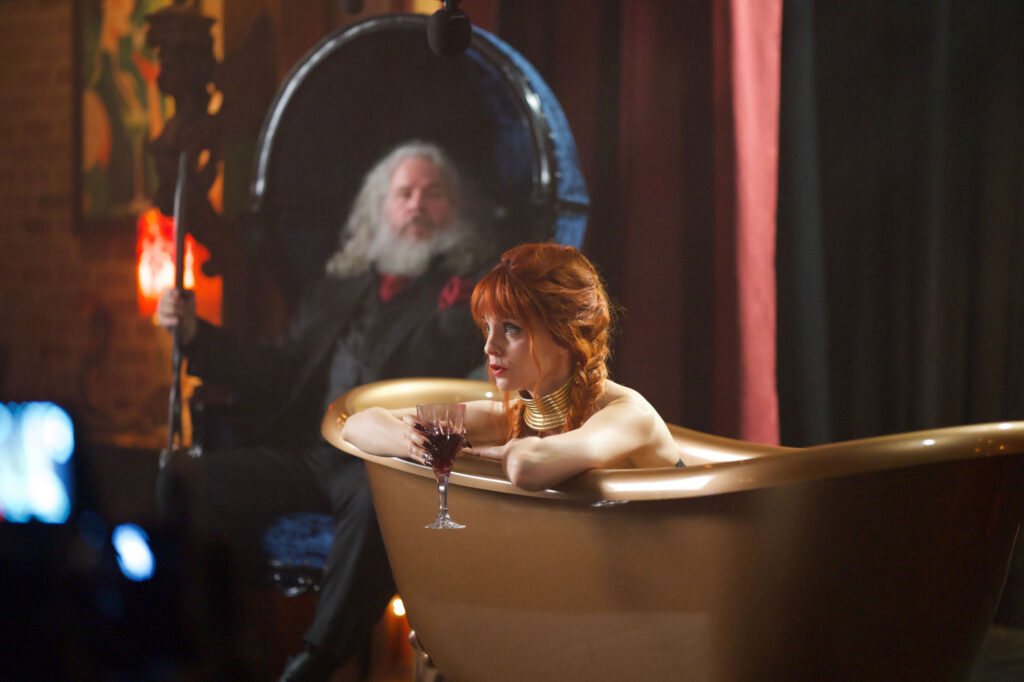
Set in the modern day American South, Elizabeth (Mena Suvari) runs an absinthe bar with Joan (India Eisley) and Helena (Sarah Dumont), which they use as a lair to lure their innocent and not-so-innocent victims via a dating app. Underground, they sleep in coffins, get ready for parties, and dispatch their victims so they can stay fed. Elizabeth, however, still continues her ritual of bathing in women’s blood as one scene shows her sat in a bathtub with three young women dangling above her, tied upside down like bats. Her right-hand man Chuck (Mark Boone Junior) cuts their heads off, allowing their fresh, virginal young blood to cascade into the tub and all over Elizabeth, who rubs the blood into her skin like lotion. Meanwhile, the arrival of vampire hunter Cora (Dichen Lachman), a former mercenary, threatens Elizabeth’s clan, but the all-powerful vampire isn’t worried.
Writer and director Adam Sherman honours and expands upon pre-existing vampire lore. While they still can’t see their own reflections in mirrors, the vampires are able to be captured on video cameras, which allows them to take full advantage of modern dating apps, setting up video calls to seduce men and women. In addition to this, the vampires look like green fairies in their true forms. The effects here are somewhat janky, but it gets the job done and contributes to the film’s distinct visual style. The vampires have the power of compulsion and can drive someone crazy. “Think happy thoughts,” intelligence officer Alexis (Rosa Salazar) warns Cora, “so the demons don’t get in your head and make you murder us both in the night.”
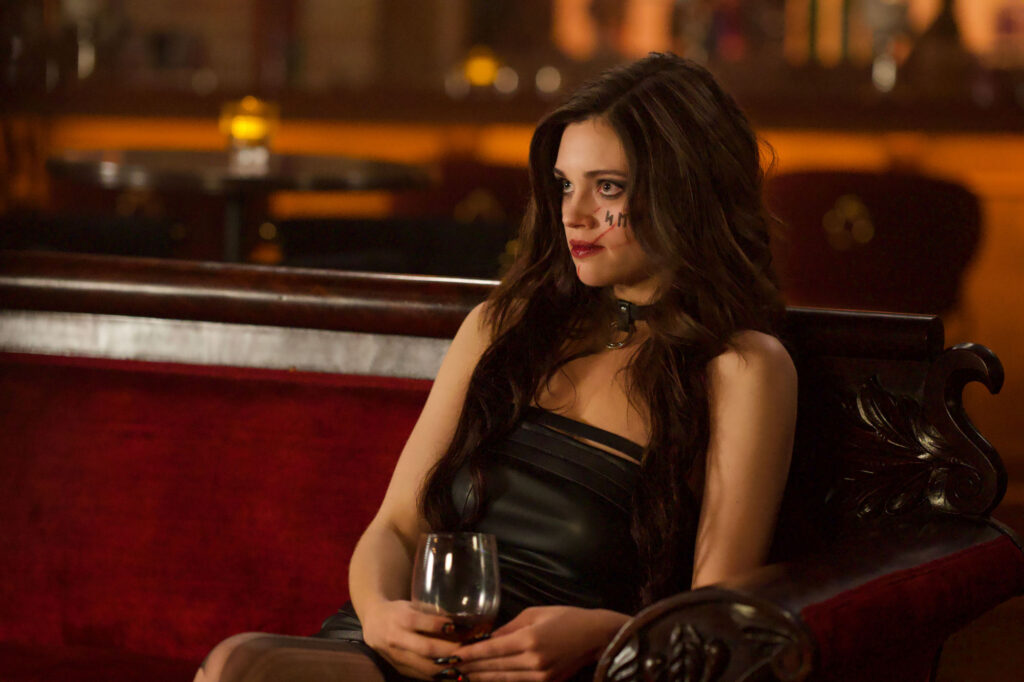
Vampires of the Velvet Lounge is highly stylised dark noir, mixed with some comedy. It has an opening title sequence which sets the film’s atmosphere as it immerses us in skeletons, graves, blood, and alluring fanged women, set to Anna Calvi’s “Ain’t No Grave.” The film’s dark cinematography, with odd pops of changing singular colours, alongside Lachman’s husky narration is reminiscent of graphic novel films like Sin City, which combines 1940s noir. The trio of vampires are sexy and seductive, wearing gothic-inspired black leather and lace, while Cora rocks militaristic blacks and greens. The characters look cool as hell, very punk rock alongside the buckets of blood and exaggerated action and violence. The soundtrack is one of the film’s strengths, utilising iconic hits such as Edwyn Collins’ “Never Met A Girl Like You Before.”
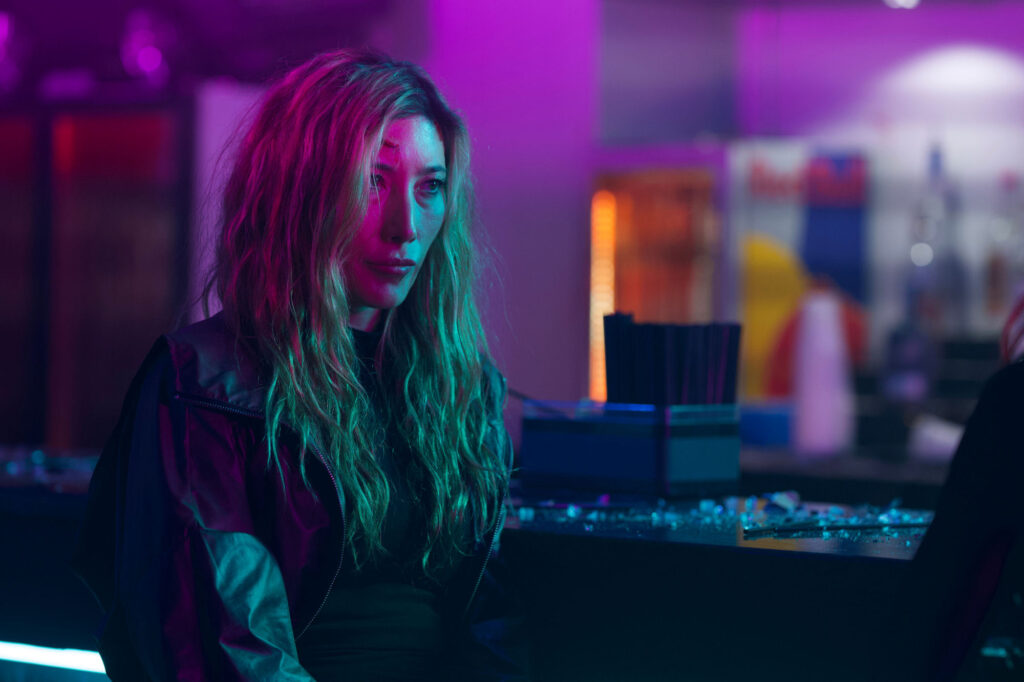
Cora is the film’s weakest element. Her character is very underdeveloped as she is given little to do. Wanting to burst into the absinthe bar guns blazing, she is forced to wait and play it safe. A nod to the noir influences, Cora is always saying things like, “War is a game best played with a grin,” but Lachman’s delivery is often stilted and the dialogue feels awkward and derivative. It tells us about Cora’s character without actually showing it. Towards the end, Cora wonders if her passion for killing Elizabeth allowed her to fall in love with her, something that is bewildering because there is very little development or chemistry between them. They are supposed to be “dating” each other as their cover—though both parties are privy to the truth—but this set up isn’t explored. Investing more into this plot line might have gone a long way to flesh out Cora’s character, but the short scenes of them talking on video chat were the worst ones in the entire film, so maybe it’s for the best. Cora is supposed to be a badass assassin, but her double-pistol wielding defence is saved for the film’s final 15 minutes. While it does serve some fun and rewarding action—in bisexual lighting no less—it does feel underwhelming to have waited all this time for Cora to still lack any real character development.
It’s a shame that Helena is a remarkably absent character, but we do get much more from Elizabeth and Joan, a relationship that Sherman explores well. Elizabeth is a predator who lives for hunting her next victim, but feral Joan is growing tired of their way of life. She is depressed and wants more, something that comes to light through Stephen Dorff, Lochlyn Munro, and Tyrese Gibson’s trio of lawyer friends, who end up on the receiving end of Elizabeth and Joan’s thrills. The vampire is always an interesting device to examine humanity, morality, mortality, and identity. It also explores themes of damned souls and humans being lucky enough to escape to heaven in death. Sherman explores these well through Joan, but falls short with the other characters whose interior worlds are dying to burst out of them in a way that would add more depth to the film.
Vampires of the Velvet Lounge is a fun story with some familiar beats and original ideas that is let down by poor writing. Sherman struggles to strike that difficult balance between incorporating Southern noir into a camp vampire flick that does its characters justice. However, there is still a lot of fun to be had in watching the likes of Suvari, Eisley, and Salazar, who all mesmerise on screen. Even Dorff, Munro, and Gibson are having a blast here. Lachman is still entertaining despite them doing her character dirty, though a twist at the end does pose an intriguing set up for a sequel. While watching Vampires of the Velvet Lounge, you get the sense that Sherman had fun writing and making this, that his bringing to life everything he’s ever wanted in a film is actually rather infectious.
Strand opens Vampires of the Velvet Lounge exclusively in select markets on 20th March, including New York and Los Angeles.

Leave a Reply